
Continuous monitoring
Risk scores update as new signals arrive - not just at annual review.
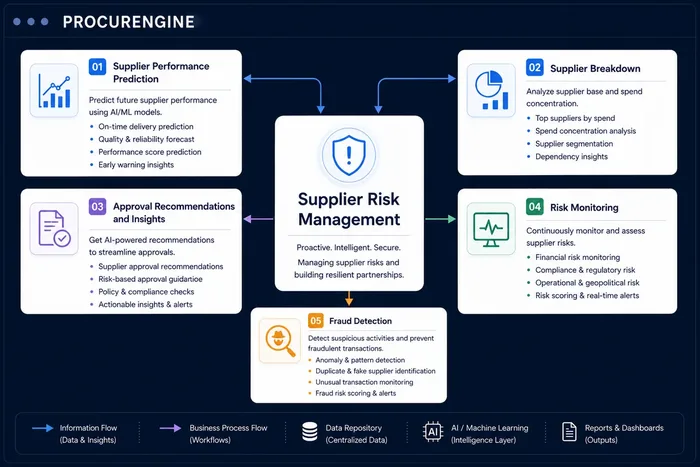
Continuous financial, compliance and geopolitical risk monitoring across your supplier base - so risk surfaces as an early signal, not a supply-chain disruption.
Risk scores update as new signals arrive - not just at annual review.
Notifications when a supplier's risk tier changes materially, before it becomes a disruption.
Financial, compliance, cyber and geopolitical signals combined into one risk view.
Risk signals appear directly where your team already manages supplier relationships.
Credit signals and financial stability indicators to flag suppliers under strain.
Certification status, regulatory actions and sanctions screening.
Signals on a supplier's security practices where a data or system relationship exists.
Exposure to regions with elevated operational or regulatory disruption risk.
Single-source and category concentration views to guide diversification decisions.
Define what "high risk" means for your business, by category and criticality.
Most supplier risk programmes are annual questionnaires. A supplier completes a form, a score is recorded, and the file is opened again twelve months later or when something has already gone wrong. The exercise is not useless, but it measures the supplier's willingness to complete a form at a point in time, which is not the same as their financial health this quarter.
Risk does not arrive on the review cycle. A supplier's financial position deteriorates over months, a sanctions listing changes overnight, a port disruption or a regional escalation changes lead times in a week. The gap between when a signal exists and when the annual process would have found it is where disruption lives.
Continuous monitoring closes that gap by watching external signals against the supplier base as they arrive and alerting when a supplier's tier changes materially. Multi-dimensional scoring matters here: financial, compliance and geopolitical exposure are different risks with different responses, and a single blended number tends to hide the one that is moving.
The response depends on the category. A risk signal on a leverage supplier with several qualified alternatives is a sourcing decision. The same signal on a bottleneck or strategic supplier - limited alternatives, long qualification, deep dependency - is a continuity problem that has to be worked before it becomes urgent, which is why risk monitoring belongs alongside category classification rather than in a separate compliance workflow.
Who uses it. Procurement and supply-chain teams acting on early signals, risk and compliance functions evidencing that monitoring exists, and operations, who feel a continuity failure first.
What it connects to. The supplier master built at onboarding, category classification, and sourcing - so a deteriorating supplier in a category with alternatives triggers an event rather than a memo. It sits alongside supplier management rather than replacing it.
What it does not do. Monitoring is not mitigation. A score that changes and produces no action is an audit artefact. The value is in what the alert triggers, which is a category and continuity decision rather than a scoring one.
Continuous risk monitoring, running on your own supplier base.