
Unstructured demand
Requirements that arrive as email threads produce fragmented events, inconsistent scope and bids that cannot be compared like for like.
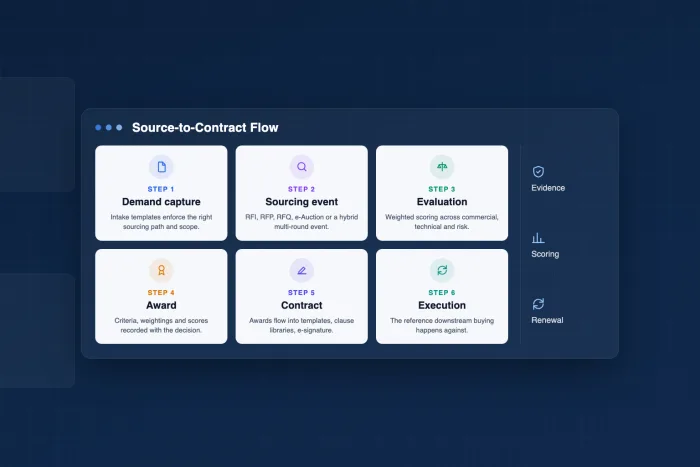
Demand capture, sourcing events, evaluation, award and contract execution on one platform - with the same policy engine, data model and reporting used downstream in Procure-to-Pay. The decision trail survives from the criteria you set to the contract you sign.
Everything Procure-to-Pay executes was decided upstream. If demand arrives unstructured, if evaluation criteria shift mid-event, or if the award never reaches the contract cleanly, no amount of downstream discipline recovers the value.
Requirements that arrive as email threads produce fragmented events, inconsistent scope and bids that cannot be compared like for like.
When weightings are agreed after bids arrive, the award becomes hard to defend - and harder still to explain at audit.
Terms negotiated in the event get re-keyed into a contract by someone who was not in the room. Detail is lost in the handoff.
An agreement that buyers cannot locate at the moment of purchase is, commercially, an agreement that does not exist.
Intake and category templates enforce the right sourcing path - competitive, contracted or catalog - and collect the scope detail an event needs before it opens.
RFI, RFP, RFQ, e-Auction or a hybrid multi-round event, templated and reusable across categories so each new event starts from a known-good structure.
Multi-attribute weighted scoring across commercial, technical and risk criteria, with configurable evaluator panels and total cost models for like-for-like comparison.
The award carries its justification: criteria, weightings, scores and the panel decision, recorded as a trail from criteria to outcome rather than assembled afterwards.
Awards flow straight into contract templates and clause libraries and out to e-signature. The negotiated terms carry across without re-keying.
The contract becomes the reference downstream purchasing buys against, and the record that surfaces ahead of renewal rather than after expiry.
Most contract value leaks after signature, not before it. The commercial work is done, the terms are agreed - and then the agreement sits in a repository that the people raising requisitions never open. Off-contract buying is rarely defiance. It is usually a buyer who could not find the contract, or did not know one existed.
Keeping Source-to-Contract on the same platform as Procure-to-Pay changes that, because the contract stops being a document and becomes the reference the purchasing workflow resolves against. When a requester describes a need, the platform can route them to the agreement already in place rather than to a new supplier at list price. The compliance question moves from policing behaviour to removing the reason for it.
The same connection protects the audit position. Because the criteria, the scoring, the award decision and the resulting contract are recorded in one sequence, the question why did this supplier win? is answered by the record rather than reconstructed from memory and email. That matters most in regulated and publicly funded procurement, where the defensibility of the process is part of the deliverable.
Renewal is the other half. A contract record that surfaces ahead of expiry gives the category team time to run a competitive event; one that surfaces afterwards leaves them negotiating from a position with no alternative - which is the situation our guide to BATNA in procurement describes as the most expensive place a buyer can stand.
Scoped to your sourcing, evaluation and contracting flow.