
New Free whitepaper: the Kraljic Matrix applied to 20 real EPC procurement categories - get the PDF.
For Chief Procurement Officers

A savings story you can defend at the board.

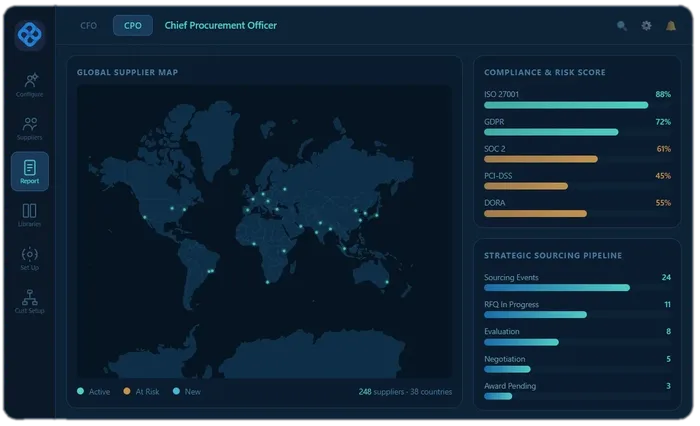
Enterprise-wide visibility into spend, supplier risk and process performance - with savings figures your CFO trusts, because they're tied to real transactions, not spreadsheet estimates.
procurEngine for CPOs
What CPOs get

Visibility, governance and a story that holds up.

Enterprise-wide spend visibility

One consolidated view across business units, regions and ERPs - no more quarterly data reconciliation projects.

Defensible governance

Policy-aware workflows and full audit trails, so procurement decisions withstand internal and external scrutiny.

Savings that hold up under audit

Savings tracked to specific sourcing events and validated against baseline - not spreadsheet estimates.

In practice

What the CPO is actually accountable for

A CPO is accountable for two things that pull in opposite directions: a savings number that survives scrutiny, and a function whose capacity is finite. Most procurement organisations are not short of opportunities. They are short of the attention to pursue them, and they spend that attention badly - distributed evenly across categories rather than concentrated where it changes the outcome.

The first problem is credibility. A savings figure built from spreadsheet estimates and category-manager judgement is not a number a CFO can take to a board. Tying savings to specific sourcing events, and those events to the orders and invoices that followed, is what turns a claim into evidence. It is also what makes the number smaller and more defensible, which is usually the right trade.

The second is allocation. Deciding where sourcing capacity goes is a category-strategy question - which categories are price battlegrounds, which are partnerships, which are continuity risks, and which deserve automation rather than attention. Our guide to applying the Kraljic Matrix sets out how that classification is made concrete rather than left on a slide.

Underneath both sits governance. Policy that is published but routinely routed around does not reduce risk; it relocates it. Governance that is enforced at the point of request - so the compliant path is also the easy one - is the only version that shows up in the numbers.

Fit

What it connects to

Enterprise-wide spend visibility across business units, regions and ERPs; supplier risk for the exposure view; and orchestration so policy is enforced in the workflow rather than in a manual.

What it does not do. Visibility is not strategy. A consolidated spend view tells you where the money went; deciding what to do about it is still the work, and no dashboard substitutes for it.

Measured on

The numbers a CPO reports, and what moves each one.

Procurement leaders are rarely measured on activity. These are the figures that reach an executive committee, and the part of the platform that changes each.

What you report What makes it hard What moves it
Realised savings against target Savings claimed at award rarely survive contact with the invoice, so finance discounts the number. Strategic sourcing tied through to invoices
Spend under management Spend that never reaches procurement cannot be reported on, and is usually the spend worth having. Intake management and spend analytics
Contract coverage and compliance Buying outside an agreed contract is invisible until someone audits it. Source-to-contract and procure-to-pay
Cycle time, request to order The delay is usually waiting for approvals, not sourcing, and nobody measures the waiting. Approval workflows
Supplier risk exposure Risk is assessed at onboarding and then assumed to hold for years. Supplier risk management
Before you commit

What CPOs put to us before they buy.

We already have sourcing in our ERP. Why add another system?
Because the two are doing different jobs. An ERP records the transaction after a decision is made; sourcing is the work of arriving at the decision - running competitive events, holding supplier tension, comparing on more than price. If your ERP module is being used and suppliers participate willingly, you may not need us. Where it usually breaks down is participation, which is why our integration approach assumes the ERP stays and remains the system of record.
Our category managers will not adopt another tool.
This is the most common reason procurement platforms fail, and it is worth taking seriously rather than answering with a feature list. Adoption follows from whether the tool removes work rather than adding a step - which is why intake and approvals matter more to adoption than sourcing does. One customer came to us after a platform they already owned had not gained traction; what changed it was focusing on adoption itself rather than on functionality.
How do I defend the savings number in front of finance?
By making it smaller and traceable. A figure built from category-manager estimates invites challenge; one tied to specific sourcing events, and those events to the orders and invoices that followed, can be audited line by line. That usually reduces the headline number, which is the right trade - a defensible figure survives the second meeting. Our guide on how a negotiated saving becomes a realised one sets out the chain finance will want to audit.
FAQ

CPO questions we hear often.

How can procurEngine improve procurement efficiency across the enterprise?
procurEngine digitizes and connects the complete procurement lifecycle, starting from intake and sourcing to approvals, purchase orders, contracts, and supplier management. This reduces manual work, standardizes processes, improves cycle times, and gives CPOs visibility into procurement performance across the organization.
How can CPOs gain real-time visibility into spend, savings, suppliers, and procurement performance?
Centralized dashboards and analytics consolidate data from procurement workflows, suppliers, contracts, purchase orders, and spend transactions. CPOs can monitor key metrics such as on-contract spend, realized savings, procurement cycle time, supplier performance, compliance, and category coverage.
Can the platform help increase compliance and reduce maverick spend?
Yes. Guided buying, approved supplier catalogs, contract-linked purchasing, policy-based workflows, and automated approvals help direct employees toward compliant procurement channels. This reduces off-contract and unauthorized purchasing while improving procurement control.
How does e-Procurement support strategic sourcing and supplier performance management?
The procurEngine platform enables teams to manage sourcing events, supplier discovery, evaluations, negotiations, and supplier performance in connected workflows. This helps CPOs improve sourcing outcomes, strengthen supplier relationships, and make decisions using consistent supplier and performance data.
How can CPOs measure the business impact and ROI of procurement digitization?
CPOs can track improvements across cycle time, process adoption, savings realization, compliance, automation, supplier performance, and spend visibility. These metrics help demonstrate the operational and financial impact of procurement transformation to executive leadership.
Can the procurEngine platform standardize procurement processes across multiple business units, regions, and categories?
procurEngine has configurable workflows, approval rules, procurement policies, catalogs, supplier controls, and business-unit-specific processes which can be managed within a single platform. This creates enterprise-wide consistency while allowing appropriate local flexibility.

Bring your board a number that holds up.

Start with how much of your spend is awarded without competition. Three inputs, no sign-up, and a figure you can take into a board pack.