
One standardised back office
If finance, HR and supply chain all run on one vendor and that vendor’s procurement module is adequate, the integration savings usually outweigh a better-fitting specialist.
Here's what we recommend evaluating when comparing Source-to-Pay platforms - including where we believe procurEngine stands out.
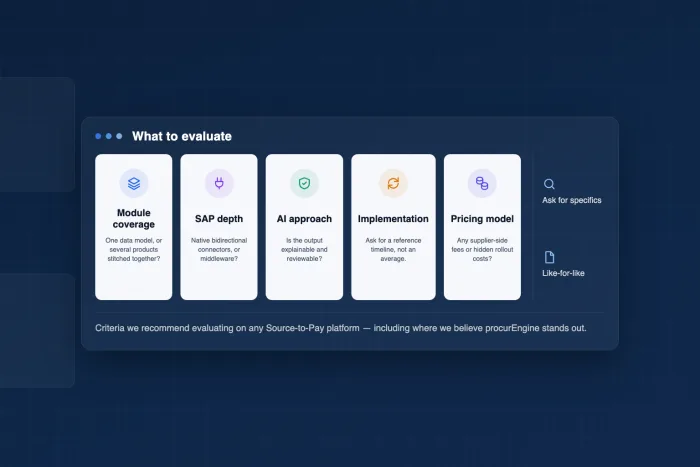
| Evaluation criteria | procurEngine | Typical alternatives |
|---|---|---|
| Module coverage | Sourcing, supplier, contract, P2P, invoicing and analytics on one data model | Varies by vendor - often requires multiple products or acquisitions stitched together |
| SAP integration depth | Purpose-built bidirectional connectors for ECC and S/4HANA, configurable per object | Varies by vendor - ranges from native to middleware-dependent |
| AI approach | Human-in-the-loop by design; explainable, grounded recommendations | Varies by vendor - evaluate whether AI output is explainable and reviewable |
| Implementation time | 8-12 weeks for a focused single-module rollout | Varies by vendor and scope - always ask for a reference timeline |
| Pricing model | No supplier seat fees; scoped to modules, users and integrations | Varies by vendor - check for supplier-side fees and hidden implementation costs |
We've avoided naming specific competitors here since public claims about another vendor's product require verification we haven't completed. Ask us for a like-for-like comparison against the specific alternative you're evaluating.
Most evaluation scorecards weight every criterion equally, which quietly favours whichever vendor has the longest feature list. A more useful method is to weight by consequence: what would actually stop this programme, rather than what would be nice to have.
The weighting below is a starting point, not a recommendation to copy. Move it to fit your situation - but move it deliberately, and agree it with IT and finance before anyone sees a demo, because scoring criteria agreed after a demo tend to describe the demo.
| Criterion | Suggested weight | Score it on |
|---|---|---|
| Integration depth | 25% | A demonstrated connection to your ERP version, not a datasheet claim |
| Supplier adoption | 20% | What a supplier pays and what they must learn before they can quote |
| Configuration vs development | 20% | How many of your requirements need code, and who maintains it at upgrade |
| Module coverage | 15% | One data model, or separate products with a shared logo |
| Total cost including suppliers | 15% | Every fee, on both sides of the transaction, over three years |
| AI explainability | 5% | Whether a recommendation can be traced and overridden, not whether AI is present |
Integration depth and supplier adoption carry the most weight here for one reason: they sink more implementations than feature gaps do. A platform missing a capability gets a workaround. A platform your suppliers will not use has no events to run.
We are not the right choice for everyone, and a comparison page that pretends otherwise is not worth reading. Three situations where a large integrated suite genuinely fits better:
If finance, HR and supply chain all run on one vendor and that vendor’s procurement module is adequate, the integration savings usually outweigh a better-fitting specialist.
Where procurement is inseparable from production scheduling and MRP, an ERP-native module has access to data no connected platform sees as cleanly.
Multinationals enforcing one process across thirty countries often want the constraint. Our strength is configuring to how a business actually buys — the opposite requirement.
Where we are a strong fit is narrower and more specific: competitive sourcing is a large part of your spend, bought-out material and subcontract packages carry real value, your suppliers are numerous and not all large, and every award has to stand up to audit.