
New Free whitepaper: the Kraljic Matrix applied to 20 real EPC procurement categories - get the PDF.
For Procurement Managers

Less chasing. More sourcing.

Templated RFx, automated supplier reminders and one dashboard for every event you're running - so your day goes to negotiation and category strategy, not status-chasing emails.
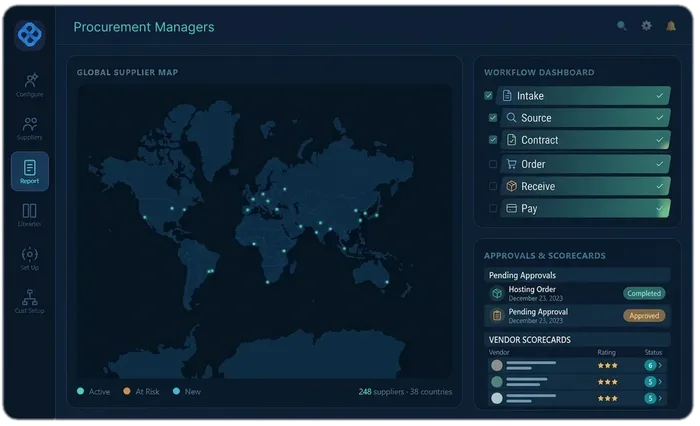
procurEngine for Procurement Managers
What procurement managers get

Your day-to-day, without the busywork.

Reusable RFx templates

Stop rebuilding sourcing documents from scratch for every category.

Automated supplier follow-up

Reminders for missing bids or documents go out automatically, not from your inbox.

One event dashboard

Every active RFx, e-Auction and negotiation, tracked in one place.

In practice

What the day actually looks like

The gap between how a procurement manager's role is described and how the day is spent is wide. The description is category strategy and negotiation. The day is chasing: chasing suppliers for missing bids, chasing internal stakeholders for specifications, chasing approvers who have not opened the email, and rebuilding an RFx document that already existed in a slightly different form three months ago.

None of that is judgment work, and all of it consumes the hours that judgment work needs. It also has a compounding effect: when running a proper event is expensive in effort, the threshold for running one rises, and more categories quietly renew with the incumbent because re-sourcing felt like too much work for the value.

Templated RFx removes the rebuild. Automated supplier follow-up removes the chasing. Parallel rather than sequential approvals remove most of the waiting. What is left is the part of the job that actually moves price and risk - which is also the part that is difficult to hire for and expensive to waste.

The second effect is on rogue spend. A procurement manager cannot police purchases they never see. Structured intake means requests arrive routed and scoped rather than arriving late, as a purchase already made.

Fit

What it connects to

Sourcing events and templates, intake for the front door, and supplier records for history and eligibility. Everything a manager needs mid-event sits in the event record rather than across an inbox.

What it does not do. It cannot decide the category strategy or run the negotiation. It gives back the hours those need, which is the point.

Measured on

What the week is judged on, and what gives the hours back.

Most of these are measured somewhere. The point is which ones are consumed by chasing rather than by judgement.

What you are judged on What makes it hard What moves it
Events run per quarter Building an RFx from scratch each time, when a near-identical one already exists from three months ago. Strategic sourcing
Supplier participation per event Suppliers drop out when bidding is awkward, and a thin field removes the competitive tension the event depends on. Supplier management and onboarding
Requisition turnaround Most of the elapsed time is an approver who has not opened the email, which no amount of sourcing skill fixes. Approval workflows and intake
Savings by category Category numbers are assembled by hand at quarter end, from spreadsheets that disagree. Spend analytics
Specification quality at intake A request that arrives underspecified is reworked later, and the rework is invisible in every metric above. Intake management
Before you commit

What procurement managers ask us first.

Another system means more admin, not less.
That is the right suspicion, and it is how most procurement tools fail. The test is whether the first thing it changes removes work you already do - templated RFx instead of rebuilding documents, approvals that chase themselves - rather than adding a place to record work you did elsewhere. If the first module deployed is one that only reports, it will feel like admin, because it is.
Our suppliers will not use a portal.
Many will not, if using it costs them anything. That is why suppliers are not charged seat fees to view an RFx, submit a quote or use the portal - a supplier weighing whether to bid should not also be weighing a fee. Participation is the metric worth watching in the first two events; if it falls, the format is wrong rather than the suppliers.
Our categories are too specialised for competitive events.
Some genuinely are. Competitive tension needs a real alternative supplier, and for bottleneck categories there often is not one - which is a category-strategy question rather than a platform one. Our guide to classifying categories sets out which respond to competition and which need a different approach entirely.
FAQ

Procurement manager questions we hear often.

How can an e-Procurement platform automate day-to-day procurement operations?
The procurEngine platform automates repetitive activities such as request intake, routing, approvals, sourcing workflows, supplier interactions, purchase orders, notifications, and status tracking. This allows Procurement Managers to spend less time on manual coordination and more time on strategic procurement activities.
Can procurement teams manage requisitions, sourcing, approvals, purchase orders, and suppliers in one platform?
The procurEngine platform connects these processes in a single digital environment. This reduces fragmented systems and allows teams to follow the complete lifecycle of a procurement request from initial need to purchase and supplier engagement.
How does procurEngine help reduce procurement cycle times and manual follow-ups?
Automated routing, reminders, notifications, approval escalation, auto forwarding, and real-time status visibility reduce the need for manual follow-ups. Teams can quickly identify bottlenecks and move requests to the next stage of the process.
Can Procurement Managers track the status of requests, approvals, sourcing events, and purchase orders in real time?
Yes. Centralized dashboards and workflow tracking provide visibility into pending, approved, rejected, delayed, and completed activities. This helps Procurement Managers monitor workload, identify bottlenecks, and take timely action.
How does the platform help improve supplier collaboration and performance management?
Suppliers can be managed through structured onboarding, communication, sourcing, evaluation, performance, and compliance workflows. Procurement teams can centralize supplier information and monitor performance against defined metrics and business requirements.
Can procurement workflows be configured to support different categories, business units, and approval requirements?
Yes. Workflows can be configured based on factors such as category, spend value, business unit, geography, budget status, and approval authority. This allows Procurement Managers to standardize processes while supporting different operational requirements.

See what competing your renewals would actually take.

Enter three numbers you already know and get the event count your uncompeted categories imply - something concrete to put in front of your head of procurement.