
Off-contract buying
Requests that never reach the negotiated agreement are bought at list price. The contract exists; the buyer never saw it.
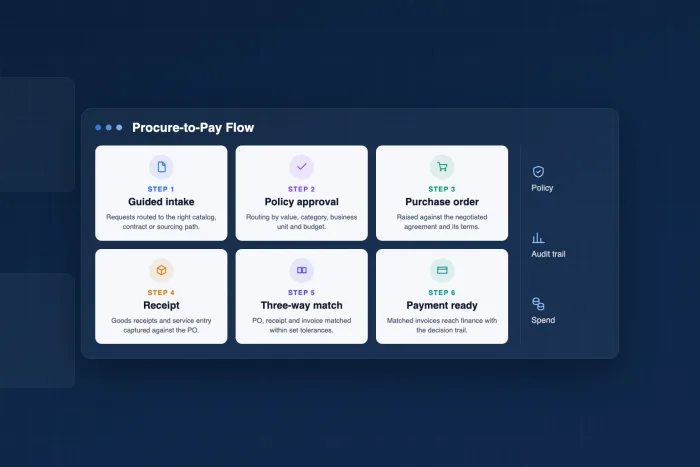
Requisition, approval, purchase order, receipt, invoice match and payment - running natively on the same platform as your sourcing events, contracts and supplier data. No re-keying between systems, and no gap between what was negotiated and what gets bought.
A negotiated rate only becomes a realized saving if the requisition routes to the right contract, the PO carries the right price, and the invoice is matched before it is paid. When P2P runs on a disconnected stack, that chain breaks quietly.
Requests that never reach the negotiated agreement are bought at list price. The contract exists; the buyer never saw it.
Approvals that sit in inboxes push cycle times out and push urgent requests around the process entirely.
Mismatches between PO, receipt and invoice consume AP time and delay payment - which suppliers price into the next quote.
When the trail spans several disconnected systems, reconstructing who approved what, and on what basis, becomes a project.
Every request is routed to the right catalog, contract or sourcing path before it becomes a rogue PO. Requesters answer plain questions; the system decides the compliant route.
Routing that reflects value thresholds, category, business unit and budget - with delegation, out-of-office fallbacks and a full audit trail on every step.
POs are raised against the negotiated agreement, carrying the contracted price, terms and delivery expectations into the transaction rather than re-stating them.
Goods receipts and service entry sheets are captured against the PO, with advance shipping notice visibility ahead of delivery so exceptions surface before they reach AP.
PO, receipt and invoice matched automatically within configured tolerances. Clean matches flow through; genuine exceptions route to a queue with the context needed to resolve them.
Approved, matched invoices reach finance ready to pay, with the complete decision trail attached - not as a reconstruction after the fact.
The usual trade-off in Procure-to-Pay is between control and speed. Tighten the policy and requesters route around it; loosen it and off-contract spend climbs. The way out is not more approval layers - it is putting the compliant path in front of the requester at the moment they ask, so the easy route and the correct route are the same route.
That is what guided intake does. A requester describes what they need in business language rather than choosing a document type. The platform resolves it to the right catalog item, existing contract or sourcing event, applies the policy that fits the value and category, and raises a requisition that is already compliant. Approvers see a request that has been pre-checked rather than one they must interrogate.
Downstream, three-way matching does the equivalent job for finance. Rather than AP chasing differences by email, the platform compares purchase order, receipt and invoice, clears what agrees within tolerance, and routes only real exceptions to a queue - with the PO, the receipt, the contract and the approval history attached. Exceptions become a short worklist instead of an investigation.
Because sourcing, contracts and P2P share one data model, the reporting question that usually takes a week - how much of our negotiated saving actually landed? - becomes a query rather than a project.
Scoped to your requisition, approval and invoice-matching flow.