
New Free whitepaper: the Kraljic Matrix applied to 20 real EPC procurement categories - get the PDF.
For IT & Digital Teams

A procurement platform IT is glad to own.

Purpose-built SAP connectors, REST APIs, SSO and role-based access control - built to pass security review, integrate cleanly, and not become another shadow-IT headache.
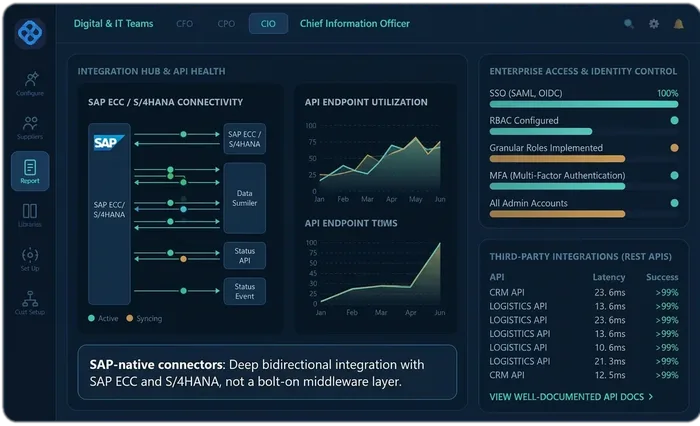
procurEngine for IT and Digital Teams
What IT teams get

Built to pass review, not just the demo.

Purpose-built SAP connectors

Deep bidirectional integration with SAP ECC and S/4HANA, not a bolt-on middleware layer.

Enterprise access controls

SSO, RBAC and MFA supported natively, no custom development needed.

Open REST APIs

Well-documented APIs for connecting any system beyond our standard connectors.

In practice

What IT is actually being asked to carry

IT's objection to a procurement platform is rarely about procurement. It is about the support burden a badly integrated system creates, and the security review it will have to pass first. Both are reasonable, and both are usually decided before anyone in IT sees a demo.

The integration burden is the larger of the two. A platform that cannot talk to the ERP properly does not remove work - it relocates it into exports, imports, reconciliation scripts and a middleware layer somebody has to own. The question worth asking during evaluation is not whether integration is possible but what shape it takes: bidirectional and object-level, or file-based with a scheduler.

procurEngine's SAP connectors are purpose-built and configurable per object, with direction and sync frequency set per object rather than globally. What syncs and in which direction is documented explicitly. They are built and maintained by procurEngine and are not SAP-certified add-ons - which is worth knowing up front rather than discovering during a technical review.

The security review is the other half. SSO, role-based access control and MFA, an ISO 27001 and 27701 certified posture, and an auditable record of every action are what let the review conclude rather than iterate. The third risk - shadow IT - is not solved by a platform at all, but by procurement having a front door good enough that the business uses it.

Fit

What it connects to

SAP ECC and S/4HANA through purpose-built connectors, other systems through documented REST APIs, identity through SSO, and data warehouses or BI through open endpoints. See integrations and security and compliance.

What it does not do. It cannot compensate for master data that is wrong in the ERP. Integration propagates whatever is there, faster.

Measured on

What IT carries after go-live, and what decides how heavy it is.

None of these appear in a procurement business case, and all of them land on IT afterwards.

What IT carries What makes it hard What moves it
Integration surface to maintain Export-import reconciliation and middleware scripts are written once and then maintained forever by whoever is on call. Bidirectional ERP connectors
Security review effort Reviews stall on evidence that does not exist yet, and the delay is attributed to IT. Security and compliance posture
Identity and access administration Every system without single sign-on becomes a joiner-mover-leaver process someone has to run by hand. Access controls and SSO
Support burden after go-live Tickets arrive against the system, not the process, and land with IT regardless of cause. Guided intake
Configuration without development Anything needing a code change to alter a workflow becomes a change request with a queue in front of it. Platform configuration
Before you commit

What IT asks before it will sign off.

Every vendor claims ERP integration. What actually ships?
A fair challenge, because "integrates with SAP" covers everything from a certified connector to a CSV drop. The questions worth putting to us, and to anyone else you evaluate: which objects sync, in which direction, on what trigger, and what happens when the target system rejects a record. Our integrations page sets out the connector scope; if a technical brief with the object-level detail would help the review, ask and we will get it to you.
Who carries support when this breaks at month end?
Worth settling in writing before purchase rather than after. What reduces the volume in the first place is where requests originate: if buyers enter requests through guided intake rather than email, most tickets that would have been "how do I raise this" never exist. That is a design point rather than a support commitment, and the commitment itself belongs in your agreement.
Where does our data live, and who can reach it?
Data residency, encryption in transit and at rest, and role-based access are covered on our security and compliance page, along with the certifications currently held. If your review needs detail beyond what is published there - sub-processor lists, logging retention, penetration test summaries - that is a direct conversation rather than a web page, and we would rather have it early than at contract stage.
FAQ

IT questions we hear often.

How does procurEngine integrate with existing ERP and enterprise systems?
procurEngine can connect with ERP, finance, HR, identity, supplier, and other enterprise systems through APIs, connectors, and integration frameworks. This enables data synchronization while reducing duplicate data entry and disruption to existing technology environments.
What security and access controls are available in procurEngine?
procurEngine offers a secure access and control environment including role-based access control (RBAC), Single Sign-On (SSO), audit trail, encryption, regional data residency, and security documentation. Such controls guarantee the security and compliance of your procurement processes, protecting your company's operations, resources, and data.
Can procurEngine scale across multiple business units, geographies, users, and procurement processes?
procurEngine can support enterprise-wide deployment across multiple entities, regions, user groups, currencies, procurement policies, and workflows. Configurable architecture allows organizations to scale without rebuilding the platform for every business unit.
How are APIs, integrations, and enterprise data exchanges managed?
APIs and integration capabilities enable the platform to exchange data with existing enterprise systems. IT teams can use these integrations to synchronize suppliers, users, financial data, purchase orders, invoices, and other relevant information while maintaining consistent data flows.
How much configuration is possible without extensive custom development?
procurEngine can support changes to workflows, approval rules, forms, business rules, user roles, notifications, and procurement policies without requiring extensive custom coding. This helps organizations adapt processes as business requirements evolve.

Start with the security and architecture detail.

Access control, encryption, audit trails and data residency - the answers your review will ask for, before you spend a meeting on them.