
New Free whitepaper: the Kraljic Matrix applied to 20 real EPC procurement categories - get the PDF.
For CFOs & Finance Leaders

Controls built into procurement, not bolted on after.

Three-way match, policy-aware approvals and audit-ready trails on every transaction - so finance gets clean data and fewer surprises at close, without adding headcount.
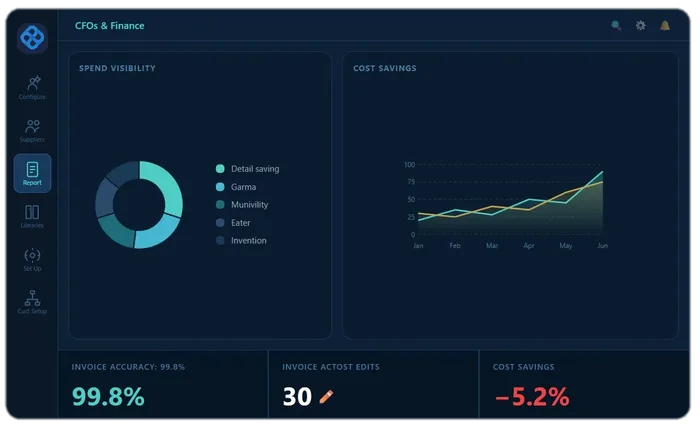
procurEngine for CFOs and Finance
What finance leaders get

Fewer surprises. Cleaner numbers.

Automated controls

Three-way match and duplicate detection catch errors before they reach payment, not after.

Audit-ready by default

Every approval, match and exception is logged - no scrambling before statutory audit.

Better cash-flow visibility

Real-time visibility into committed spend and payables position, not month-end reconciliation.

In practice

What finance is actually accountable for

The finance objection to procurement software is rarely about procurement. It is that the savings number arriving from procurement cannot be reconciled to anything in the ledger. A figure is reported, finance cannot trace it to transactions, and the two functions end up negotiating about the number rather than acting on it.

That gap is structural, not political. A saving negotiated in a sourcing event only becomes a realized saving if the requisition routes to the resulting contract, the purchase order carries the contracted price, and the invoice is matched before payment. When those steps run in disconnected systems, the chain from negotiation to ledger has no single owner, and the reported figure drifts from the realized one with nobody able to say precisely where.

The second accountability is defensibility. When an auditor asks why a supplier was chosen or who approved a payment, the answer has to be reconstructable from the record rather than from memory. A trail that spans four systems is a project to assemble; a trail in one is a query.

Both are the reason controls belong inside the transaction flow rather than as a review step after it. Three-way match, policy-aware approval routing and duplicate detection prevent the exception rather than reporting it, which is also what keeps the close from depending on chasing.

Fit

What it connects to

Baselines agreed once with finance and reused, so the same category is not measured three ways in three reviews. Spend analytics for the consolidated view across entities and ERPs, invoice automation for the matching and exception path, and the ERP as the financial system of record.

What it does not do. It cannot make a savings figure credible if the baseline was never agreed. That conversation happens before the sourcing event, not after the number is reported.

Measured on

What finance is held to, and where procurement moves it.

Procurement affects several numbers finance owns outright. These are the ones where the link is direct enough to be worth tracking.

What finance owns What makes it hard What moves it
Realized versus negotiated savings A saving agreed in a sourcing event is a forecast until the invoice matches it. Most reported savings are never reconciled. Sourcing tied to invoice matching
Committed spend visibility Commitments made at PO are invisible to finance until the invoice lands, so the forecast is always behind. Procure-to-pay and spend analytics
Invoice exception rate Exceptions are handled by people, and the cost sits in AP headcount rather than in any procurement metric. Invoice automation
Off-contract and maverick spend Buying outside an agreed contract looks identical to compliant spend in the ledger. Intake and source-to-contract
Audit and control evidence Demonstrating who approved what, and on what authority, usually means reconstructing it after the fact. Approval workflows
Before you commit

What finance puts to us before signing.

Procurement reports savings we can never find in the ledger.
That is the central complaint, and it is structural rather than political. A negotiated saving becomes a realized one only if the requisition routes to the right contract, the PO carries the agreed price, and the invoice matches it. Where those links are broken, no reporting layer can repair them. The value is in the chain being intact, not in the dashboard on top - which is also why the honest number is usually smaller than the one procurement first reports.
We are mid-way through an ERP programme. We cannot absorb another system.
Then do not replace anything. The ERP stays the system of record, and procurement work happens upstream of it - the PO and invoice still land where they always did. Our integration approach assumes the ERP is fixed and we bend around it. If your programme is at a stage where even read integrations are frozen, the honest answer is to wait.
What is the payback, and when do we see it?
It depends on which categories you put through first and how much of your spend is already competitively sourced - so any figure quoted before that conversation is a guess dressed up as a number. What we can say is where payback comes from: fewer invoice exceptions, commitments visible earlier, and savings that survive reconciliation. Pricing is scoped to your footprint rather than per seat, so the model is at least legible before you commit.
FAQ

Finance questions we hear often.

How does procurEngine provide Finance with better control and visibility over organizational spend?
procurEngine creates visibility from the initial purchase request through approvals, purchase orders, contracts, and invoices. Finance teams can monitor committed and actual spend, identify purchasing patterns, and improve control over procurement-related expenditure.
Can procurEngine help improve budget control and prevent unauthorized or excess spending?
Yes. Budget checks, approval workflows, spend thresholds, and policy-based controls can be configured to evaluate requests before commitments are made. This helps Finance identify budget exceptions and ensure the appropriate approvals are obtained.
How does e-Procurement help reduce maverick spend and improve on-contract spending?
procurEngine can guide users toward preferred suppliers, approved catalogs, negotiated contracts, and compliant purchasing channels. By making the right buying process easier to follow, organizations can reduce off-contract purchasing and increase procurement compliance.
Can procurEngine improve audit readiness and financial compliance?
Yes. Digital workflows create a structured record of requests, approvals, sourcing decisions, contracts, purchase orders, and other procurement activities. Centralized audit trails and standardized approval processes make it easier to demonstrate compliance and retrieve supporting documentation.
How does procurement automation impact working capital and cash flow management?
Better visibility into purchasing commitments, supplier terms, approvals, and procurement cycle times helps Finance improve planning and control. Connected procurement processes can also reduce delays, prevent unnecessary purchases, and support more effective management of organizational cash commitments.
How can Finance track procurement savings and validate savings realization?
Savings can be tracked against sourcing events, negotiated contracts, purchase prices, budgets, and actual transactions. Analytics can help distinguish identified savings from realized savings, giving Finance and Procurement a more reliable view of financial impact.

See how a negotiated saving becomes a realised one.

The gap between a savings number and a P&L movement is where finance loses trust in procurement. This is how the two are reconciled.