
Days, not weeks
Self-service intake and automated checks replace back-and-forth email chains.
Guided self-service intake, automated document verification and configurable approval workflows - so new suppliers are ready to transact fast, without cutting corners on compliance.
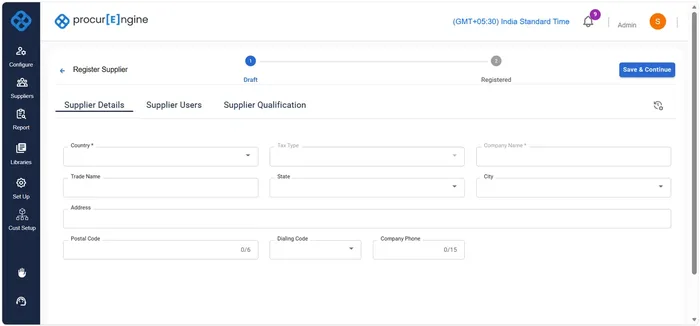
Self-service intake and automated checks replace back-and-forth email chains.
Every supplier passes the same configurable checklist for their risk tier.
Automated reminders for missing documents and expiring certifications.
Verified supplier data flows straight into the vendor master - no duplicate entry.
Suppliers receive a secure link and complete profile, tax and banking details themselves.
Documents are checked against category and risk-tier requirements, with exceptions routed for review.
On approval, the supplier record activates in the vendor master, ready for sourcing and POs.
Traditional supplier onboarding is an email thread. Procurement asks for documents, the supplier sends some of them, compliance asks for the ones that are missing, finance asks for bank details separately, and somewhere in the middle the requester who needed the supplier gives up and buys from an incumbent instead. The elapsed time is rarely measured, because it is nobody's single responsibility.
The cost is not only administrative. A long onboarding cycle is one of the quietest ways a buyer loses negotiating leverage: if qualifying a new supplier takes six weeks, the alternative supplier who would make a negotiation competitive is not available when the negotiation happens. Onboarding speed is a sourcing capability, not a back-office one.
Guided self-service intake moves the data entry to the party that holds the data. The supplier completes a structured form scoped to their risk tier, documents are verified automatically where possible, and approvals route to the right internal owners in parallel rather than in sequence. Procurement ops moves from chasing to reviewing exceptions.
Because the supplier record is the same one used downstream, the detail captured at onboarding carries into risk monitoring, sourcing events and the ERP vendor master without re-keying, which is also what keeps it accurate six months later.
Who uses it. Procurement operations own the process, compliance owns the checklist for each risk tier, and the requesting business unit is usually the party actually waiting. Suppliers themselves do most of the data entry.
What it connects to. Approved suppliers flow into the supplier master used by supplier management and risk monitoring, into sourcing events as eligible bidders, and into the ERP vendor master through the same integration layer that carries orders and invoices.
What it does not do. Speed does not substitute for judgment on qualification. The checklist still has to be right for the risk tier, and the tiers themselves have to reflect real exposure rather than spend size. Automation makes a good checklist fast and a poor one fast. Reviewing what each tier actually verifies is worth doing before onboarding volume increases, not after a supplier clears a check that never applied to them.
The self-service onboarding flow, start to finish.