
What Is BATNA
Why BATNA is not your target price or your walk-away number, and what it actually means to answer "what is our next best move?"
By Anupam Aggrwal, CEO & Co-Founder · 22 April 2026
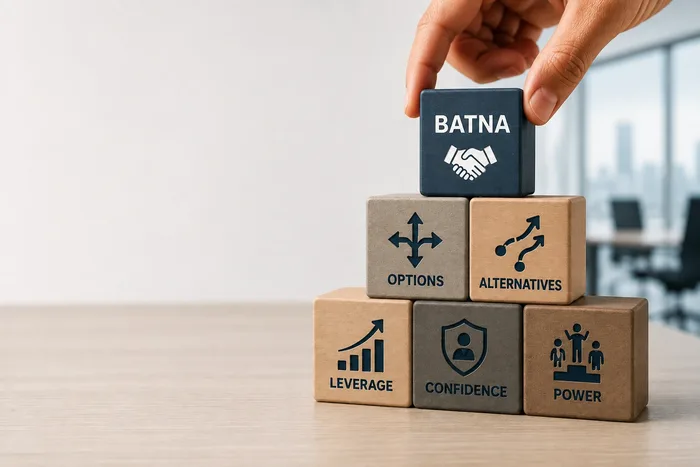
Every procurement negotiation has a turning point. It is the moment when a supplier senses that you have no real alternative, and quietly stops competing. You may not see it happen, but you will feel it in the final price.
BATNA (Best Alternative to a Negotiated Agreement, introduced by Roger Fisher and William Ury) is the concept that determines whether that turning point works in your favour or against you. It answers one straightforward question: if this negotiation fails, what is your best available option?
This whitepaper covers what weakens a BATNA without anyone noticing, a six-step approach to building one before it is needed, and how BATNA connects to supplier categories and to game theory.
BATNA stands for Best Alternative to a Negotiated Agreement. Introduced by Roger Fisher and William Ury, it answers one straightforward question: if this negotiation fails, what is your best available option?
Your BATNA is not your target price. It is not your walk-away number. It is not what you wish you could do. It is what you can actually do if the negotiation does not result in an agreement. In procurement terms: if this supplier does not come through, what is our next best move?
That next move could be another qualified supplier ready to take the order. It could be a redesigned specification that opens up a different supply base. It could be an in-house alternative, or a short-term workaround while you develop a better option. The specifics vary by category, but the principle is consistent: the strength of your BATNA determines how much negotiating power you actually hold, regardless of how many suppliers are on your list.
Most procurement teams focus on negotiation tactics - opening positions, discount structures, how to respond to supplier pushback. All of that matters. But it sits on top of a more fundamental question: what happens if the negotiation breaks down?
If your honest answer is that you have no real alternative, then your negotiation position is weaker than it appears on paper. Suppliers figure this out faster than buyers typically expect. Over years of interactions, suppliers develop a clear sense of which buyers can actually walk away and which ones cannot.
Every procurement negotiation has a turning point. It is the moment when a supplier senses that you have no real alternative, and quietly stops competing. You may not see it happen. You will feel it in the final price.
Buyers routinely overstate their BATNA. The alternative supplier "on the list" and the alternative supplier that could actually deliver on the required timeline, quality and volume are frequently two very different things.
Four patterns appear repeatedly in mid-sized organizations, and none of them involves a decision anyone remembers making.
Your BATNA varies significantly depending on the type of category you are dealing with, which makes the Kraljic Matrix a useful companion framework.
For leverage categories, your BATNA is naturally strong. Multiple suppliers, standard specifications and easy switching mean you can credibly walk away, and that credibility is what drives competitive pricing.
For strategic categories, your BATNA is often weak. Limited suppliers, high switching costs and deep operational dependency mean that walking away is difficult in practice. This is precisely why the goal there is not price pressure but controlled dependency and long-term alignment.
For bottleneck categories, your BATNA may be almost non-existent in the short term. A single qualified supplier with long lead times and no viable substitute is a situation where you need to invest in building a BATNA over time, not assume one exists today.
Understanding which quadrant a category sits in is the first step toward honestly assessing your BATNA.
The good news is that a BATNA is not fixed. It can be deliberately built and strengthened over time. A credible BATNA has to be built in advance: identifying genuinely qualified alternate suppliers, running structured sourcing events regularly enough that alternatives stay live rather than theoretical, and keeping switching costs visible and current rather than assumed.
The biggest mistake is waiting until a negotiation is imminent to start thinking about alternatives. BATNA development is a medium to long-term exercise. Qualifying a new supplier takes time. Redesigning a specification to open up a different supply base takes time. That work has to start well before the next contract renewal.
Two habits do most of the heavy lifting. First, test your stated alternatives rather than assuming them - a supplier on your approved vendor list who has not quoted in two years is not a live alternative. Second, run periodic competitive events even when you are satisfied with your current supplier. That keeps alternate suppliers engaged, gives you live market data, and signals to the incumbent that your BATNA is real. Structured competitive events generate near-term pricing benefit while simultaneously keeping your alternatives real for the next negotiation.
This is equally important and often overlooked. What happens to the supplier if this negotiation fails? If they are heavily dependent on your volume, their BATNA is weak. If you are a small account and they have many alternatives, their BATNA is strong. Understanding both sides of this equation gives a much clearer picture of the real negotiating dynamics.
BATNA runs both directions. A supplier facing excess capacity, softening demand or a shrinking product line has a much weaker BATNA than one turning away business, and that asymmetry is often the single biggest determinant of how a negotiation actually plays out - more so than any tactic used in the room.
BATNA is essentially the outside option in a negotiation game. It sets the floor below which no rational party should agree to a deal. When both sides understand each other's outside options, they negotiate more efficiently and with less positional posturing.
In a well-structured procurement event you are not just negotiating with one supplier. You are creating a game where each supplier's offer is shaped by their assessment of your alternatives. B2B procurement is never a one-time, one-to-one conversation: every supplier is watching your behaviour, tracking market conditions, and sizing up the other options you may have. Game theory is not an academic overlay here - it describes what is already happening in every supplier negotiation. The only question is whether you are applying it deliberately or leaving the outcome to chance.
The worst outcome is to walk into a negotiation unaware of how weak your BATNA is, use aggressive tactics that do not match your actual position, and damage a supplier relationship without getting the result you wanted.
The full whitepaper takes this further with the six-step programme for assessing and building BATNA across a category portfolio, including how to calculate your BATNA number - the true cost of your best alternative once switching, qualification, transition time and operational disruption are counted - so you enter every negotiation with a defensible reservation point.
Why BATNA is not your target price or your walk-away number, and what it actually means to answer "what is our next best move?"
How BATNA strength varies by Kraljic quadrant, and why suppliers figure out who can actually walk away faster than buyers expect.
Single-source dependency, supplier-shaped specifications and comfortable relationships that quietly erode negotiating power.
From honestly assessing your current position to knowing your BATNA number and understanding the supplier's own alternative.
Why every sourcing event is a game shaped by both sides' outside options, not a single, isolated conversation.
Why BATNA strength should be assessed deliberately, category by category, rather than inferred from habit.
Procurement leaders and category managers preparing for supplier negotiations, and anyone building a shared vocabulary for negotiating power across the team.
The full guide includes the six-step approach in worked detail, and how BATNA connects to the Kraljic Matrix and to game theory in B2B negotiation.