
What Is Source-to-Pay (S2P)?
A 2026 guide to how it works alongside your ERP and what AI changes
By Anupam Aggrwal · 19 October 2026
Executive Summary
Many procurement leaders ask me a simple question: "Why do we need an S2P platform when we already have SAP, Oracle, Microsoft Dynamics, or another comprehensive ERP with a material management module?" It is a fair question, and in my experience, it is often the first objection that comes up when an organization starts evaluating procurement technology. The answer lies in understanding what an ERP was designed to do and what modern procurement requires it to do. An ERP is primarily a system of record, built to provide consistency, financial control, and reliable transaction processing. Procurement, however, involves much more than transactions. It involves identifying requirements, finding suppliers, running sourcing events, negotiating, managing supplier relationships, obtaining approvals, allocating business, monitoring supplier performance, and managing risk. This is where Source-to-Pay, or S2P, comes in. S2P does not replace the ERP. It fills the gap between the business need and the transaction that ultimately gets recorded in the ERP. It also creates the connected procurement data and workflows that allow automation and AI to become genuinely useful, helping procurement teams analyze information, identify opportunities, and make better decisions without replacing human judgment.
Do You Need S2P If You Already Have an ERP?
I have heard this question many times during procurement transformation projects. A company has invested significantly in SAP, Oracle, Microsoft Dynamics, or another ERP. Purchase orders are being created, goods receipts are being recorded, invoices are being processed, and finance has the information it needs for accounting and reporting. So the natural question is, why introduce another platform? My answer is usually to ask a different question: "Where does your procurement process actually begin?" In most organizations, it does not begin with a purchase order. It begins when someone in the business needs something. From a pre-approved Annual or Project Budget (or an exception), a requirement is raised, procurement determines what exactly is needed, identifies potential suppliers, issues an RFQ or RFP, evaluates responses, negotiates commercial terms, obtains the necessary approvals, selects the supplier, and decides how the business should be allocated. Only then does the purchase transaction typically enter the ERP.
This distinction is important because an ERP is very good at recording and controlling the transaction, but it was not primarily designed to manage all of the procurement activity that happens before that transaction. We often describe the ERP as the system of record and S2P as the procurement execution layer that works alongside it. The ERP provides structure, control, consistency, and financial integrity. S2P provides the flexibility, collaboration, supplier interaction, sourcing capability, workflow, and speed that modern procurement organizations need. It also creates something that is becoming increasingly important: a connected source of procurement information. AI can provide recommendations only when it has access to relevant, reliable, and contextual data. If sourcing information is in email, supplier information is in Excel, and approvals are in someone's inbox, there is very little useful procurement context for AI to work with.
What Is Source-to-Pay?
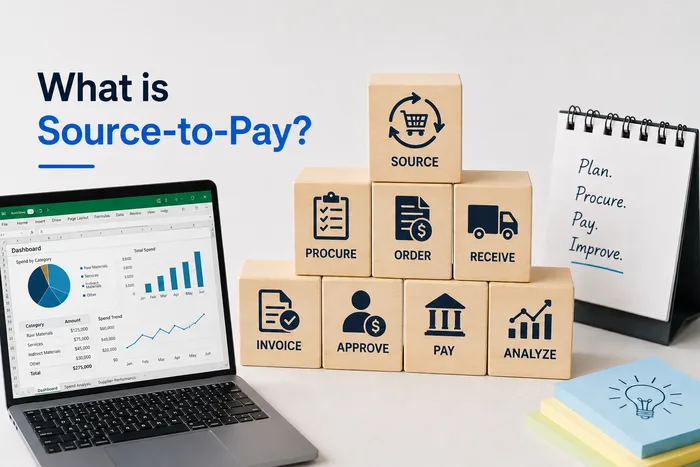
Source-to-Pay, commonly called S2P, is the end-to-end procurement process that starts with identifying a business requirement and ends with payment to the supplier. It typically includes intake, sourcing, supplier qualification, negotiation, supplier selection, approvals, purchasing, fulfillment, invoicing, and payment. The important point is that these activities are connected. S2P is not simply a collection of procurement platform modules. It is an operating model that connects the strategic and transactional sides of procurement so that information captured at one stage can be used at the next stage without being recreated manually.
Unfortunately, this is not how procurement works in many organizations today. A business user sends a requirement by email, a buyer maintains supplier information in Excel, an RFQ is issued by email, supplier responses are downloaded and compared manually, negotiations happen through phone calls and email, approvals are obtained through long email chains, supplier performance is maintained in another spreadsheet, and eventually the purchase order is created in SAP or another ERP. The ERP records the final transaction, but much of the decision-making history that led to that transaction exists outside the ERP. This is one of the biggest gaps that an S2P platform is designed to close, and it is also one of the reasons AI has historically struggled to deliver meaningful value in procurement. AI cannot reliably analyze procurement decisions when the underlying information is fragmented, incomplete, or sitting in places the organization cannot easily access.
When S2P connects these activities, procurement begins to create a much richer data environment. Supplier responses, sourcing events, negotiated prices, approval decisions, supplier qualifications, performance information, purchase orders, and fulfillment data can be connected. This gives procurement not only better visibility but also the foundation for AI assisted procurement. Instead of asking AI to make sense of disconnected documents, the organization can give it a structured procurement context in which recommendations become much more meaningful.
What Changes Once S2P Is in Place?
The biggest change is not the platform itself. It is how procurement operates every day. When S2P is implemented properly, procurement moves from a collection of disconnected activities to a connected process. A business user can submit a requirement through intake, procurement can review it and determine the appropriate sourcing strategy, qualified suppliers can be invited to participate, an RFQ, RFP, or e-Auction can be conducted, supplier responses can be evaluated, negotiations can be documented, approvals can be routed to the right people, and the business can be awarded through one connected workflow. The information does not have to be repeatedly copied between emails, spreadsheets, and systems. AI can assist within this workflow by helping classify requirements, summarize supplier responses, identify unusual pricing, compare commercial terms, highlight missing information, and bring relevant information to the buyer's attention.
The same principle applies to supplier management. Instead of maintaining supplier information in multiple spreadsheets and asking suppliers repeatedly for the same information, the organization can maintain a current supplier database with structured qualification and onboarding processes. Supplier performance can be tracked against defined measures rather than being discussed only during an annual review. AI can help identify patterns in supplier performance, flag deteriorating service levels, identify recurring quality or delivery issues, and help procurement focus its attention on suppliers that require intervention. New supplier qualification becomes a controlled workflow instead of an email exercise, while AI can assist in reviewing submitted information and identifying gaps for the procurement team to investigate.
Business allocation can also become much more structured. Instead of maintaining supplier allocation in individual spreadsheets, procurement can record the allocation decision, approval, and supporting rationale in the system. Over time, this creates a valuable history of how business has been distributed across suppliers. AI can use this information to identify concentration risks, unusual allocation patterns, or changes in supplier share that may deserve management attention. The objective is not for AI to decide which supplier receives the business. The objective is to help the procurement professional see the information that should influence that decision.
S2P vs P2P: How They Fit Together
The other important part of Source-to-Pay is Procure-to-Pay, or P2P. While sourcing and supplier management address the upstream part of procurement, P2P manages what happens after a supplier has been selected. It connects the approved supplier, purchase requisition, purchase order, fulfillment, receipt, invoice, and payment processes into a connected workflow. Instead of procurement teams and business users managing these activities through emails, spreadsheets, and disconnected systems, the process becomes more structured and visible from purchase through payment.
This connection is important because sourcing savings have little value if they are not carried into execution. An organization may negotiate excellent pricing during an RFQ, but if purchase orders are raised outside the agreed process, suppliers deliver against outdated terms, or invoices cannot be matched efficiently, part of that value can be lost. A well-connected S2P environment helps ensure that negotiated terms flow into purchasing and that procurement has visibility into what happens after the award.
What Should an S2P Platform Actually Achieve?
The real measure of an S2P platform is not how many features it contains. It is what changes in the procurement function once the platform is adopted. The objective should be to create a procurement environment where information is connected, processes are streamlined, decisions are more transparent, and procurement teams can spend more time managing suppliers and creating business value rather than coordinating administrative activity.
The key outcomes should include:
- Streamlined supplier database and lifecycle management: A single, reliable view of supplier capabilities, qualifications, certifications, risk, performance history, and business relationships. Supplier onboarding, qualification, documentation, and performance evaluation should become structured, consistent, and easier to manage throughout the supplier lifecycle.
- Faster sourcing and negotiations: RFQs, RFIs, RFPs, supplier responses, evaluations, negotiations, and awards should move from spreadsheets and email into a structured and auditable workflow. AI can further assist by summarizing supplier quotations, highlighting unusual pricing, identifying missing information, and supporting negotiation preparation.
- Faster and more transparent approvals: Business requirements, purchase requests, sourcing decisions, and exceptions should move through clearly defined workflows. Procurement leaders should have visibility into the status of each request, who needs to act, and where delays are occurring.
- Better supplier business allocation: Procurement should have a clear view of how business is distributed across suppliers, categories, plants, and locations. This helps identify supplier concentration, diversification opportunities, and situations where business allocation may not reflect supplier performance, competitiveness, or risk.
- End-to-end visibility from requirement to payment: Procurement should be able to connect the complete journey from what the business requested, through supplier selection, negotiation, award, purchase order, fulfillment, receipt, invoice, and payment. This makes it easier to measure procurement performance and ensure negotiated value is actually realized.
- Better procurement intelligence: Connected sourcing, supplier, purchasing, performance, and spend information should allow procurement teams to move beyond simply reporting what happened to understanding why it happened and where attention is needed. AI can help identify patterns, exceptions, pricing anomalies, supplier performance trends, and potential risks, while procurement professionals remain accountable for the final business decisions.
The result is not simply a more automated procurement process. It is a procurement function with better supplier visibility, faster execution, stronger governance, more reliable data, greater transparency, and better decision support. That is ultimately where the value of Source-to-Pay lies.
The Key Modules of an S2P Suite
The exact architecture will vary from one platform to another, but I generally look for six core capabilities in an S2P suite.
- Intake Management replaces the traditional process of receiving purchase and sourcing requests through emails, phone calls, and informal conversations. It creates a structured entry point into procurement and gives procurement visibility into demand before it becomes a transaction. With AI, intake can become more intelligent by helping classify Purchase Requisitions, identify and club similar requirements, suggest the appropriate procurement route, and direct the request to the right team.
- Strategic Sourcing replaces Excel based RFQs, manual supplier comparisons, disconnected negotiations, and email-based award decisions with a structured process for RFQs, RFPs, e-Auctions, evaluations, negotiations, and awards. AI can assist buyers by summarizing supplier responses, identifying price differences, comparing commercial terms, highlighting unusual responses, and bringing historical sourcing information into the decision process. This is where procurement can create significant value through better sourcing strategies and negotiations. I have written earlier about how the Kraljic Matrix can help procurement teams determine where they should focus their negotiation effort rather than treating every category in the same way.
- Supplier Lifecycle Management replaces supplier spreadsheets and fragmented email based onboarding with a central supplier record covering qualification, onboarding, information management, performance, and eventual offboarding. AI can help identify incomplete supplier information, highlight changes in supplier behavior, and surface performance trends that may otherwise be missed.
- Procure to Pay connects purchase orders, fulfillment, invoice queries, and payment visibility with the upstream procurement process, while allowing the ERP to remain the financial system of record. AI can help identify exceptions in the transaction flow, such as unusual purchasing patterns, delayed fulfillment, or invoices that require attention.
- Supplier Business Allocation and Approval Workflows replace spreadsheets showing supplier allocation and email based approvals with structured workflows that make decisions visible, consistent, and auditable. AI can assist by highlighting concentration risks, unusual allocation changes, or decisions that differ materially from historical patterns.
- Reporting and Spend Visibility replaces manually prepared Excel reports with a more current view of spend, suppliers, categories, sourcing activity, procurement cycle times, and supplier performance. This is perhaps one of the areas where AI can have the greatest impact because procurement leaders can increasingly move from simply asking for reports to asking questions of their procurement data and receiving insights that help them decide where to focus.
The important point is that these modules should not operate as separate applications. Their real value comes from connecting the information and processes across the procurement lifecycle. That connected foundation is what makes automation possible today and intelligent procurement possible tomorrow.
S2P vs ERP: S2P Does Not Replace ERP. It Makes Procurement Better.
This is perhaps the most important point I would make to a CPO or CFO evaluating S2P. Your ERP should continue to do what it does well: serve as the system of record for transactions, financial controls, inventory, accounting, and other core enterprise processes. S2P should complement it by managing the procurement activities that require collaboration, flexibility, supplier interaction, judgment, and speed.
This is the approach we have taken with procurEngine, a cloud hosted Source-to-Pay platform built on Microsoft Azure and designed to work alongside existing enterprise systems, including SAP, Oracle and Microsoft Dynamics and other leading ERPs. The objective is to connect the procurement processes that happen around the ERP rather than asking organizations to replace systems that are already central to their business. That same architecture also provides a foundation for introducing AI into procurement in a practical way, because AI becomes part of the workflow rather than a separate tool that procurement professionals have to use outside their normal process.
The objective should not be to add another software layer. The objective should be to create a better procurement operating model. When procurement information, sourcing activity, supplier management, approvals, business allocation, and purchasing workflows are connected, the organization gains much more than automation. It gains visibility into how procurement decisions are being made and how those decisions translate into business outcomes. AI can then help procurement professionals make sense of that information faster, but the technology should remain in service of the procurement process, not become the process itself.
What Does S2P Mean for the Procurement Team?
When implemented properly, S2P changes the daily work of a procurement team. Buyers spend less time chasing approvals, maintaining spreadsheets, following up with suppliers for information, preparing reports, and moving information from one system to another. Instead, they have more time to focus on strategic sourcing, negotiation, supplier development, risk management, and business value creation. This is particularly important for mid sized companies where procurement teams may have only five or ten people supporting a significant amount of spend. In such organizations, removing repetitive administrative work can have a meaningful impact on what the procurement team is capable of delivering.
AI can extend that productivity gain further. Imagine a buyer preparing for a supplier negotiation and having the system automatically bring together the supplier's historical prices, previous bids, delivery performance, quality performance, current spend, and relevant sourcing events. Imagine being able to ask which suppliers have increased prices beyond market or historical patterns, which suppliers are becoming a concentration risk, or which categories have not been competitively sourced recently. These are the types of capabilities that become possible when connected procurement data is combined with AI.
But I would make one distinction very clear. AI should not replace procurement judgment. A procurement professional understands business priorities, supplier relationships, market conditions, operational risks, and the consequences of a decision in a way that an algorithm may not. AI should reduce the effort required to collect and analyze information so that the professional can spend more time making the right decision.
The Real Value of S2P
After more than 25 years working on procurement transformation, I have learned that technology by itself does not transform procurement. Transformation happens when technology removes friction from the process and allows people to work differently. A good S2P platform should make procurement faster without making it less controlled, give buyers flexibility without sacrificing governance, give suppliers a simpler experience, and give finance and procurement leaders better visibility into what is happening across the procurement lifecycle.
The next stage is making that connected procurement environment intelligent. AI should help procurement teams find information faster, identify exceptions earlier, recognize patterns, prepare for negotiations, and focus attention where it can create the greatest value. But AI cannot compensate for fragmented data, disconnected workflows, or poor adoption. The foundation has to be right first.
For me, that is the real value of Source-to-Pay. It is not about adding another system to the technology landscape, and it is certainly not about replacing procurement professionals with AI. It is about creating a connected procurement operating model where people, processes, technology, data, and intelligence work together.
When that happens, procurement can spend less time managing the mechanics of buying and more time influencing what the organization buys, from whom it buys, at what commercial terms, and how those supplier relationships create business value.
Questions about this article.
What is Source-to-Pay in procurement?
What is the difference between an ERP and an S2P platform?
Why do companies need S2P if they already have SAP or Oracle?
What are the main benefits of an S2P platform?
What should a company consider when selecting an S2P platform?
How does S2P improve supplier management?
Does implementing S2P mean replacing the ERP?
What is the difference between S2P and P2P?
How does S2P reduce manual work in procurement?
How does S2P improve procurement visibility?
How can AI be used in Source-to-Pay?
Is S2P useful for mid sized companies?
About the Author
Anupam Aggrwal has spent more than 25 years handling negotiations and helping organizations improve procurement performance through process transformation, digitalization, and strategic sourcing. He also gives guest lectures to supply chain students at Mays Business School at Texas A&M University and the Eli Broad Graduate School of Management at Michigan State University.