
Why Mid-Market Companies Need a Different S2P Strategy
By Anupam Aggrwal · 18 August 2026
Executive Summary
Mid-market companies cannot simply copy the Source-to-Pay strategy of a large global enterprise. The procurement challenges are different, the teams are smaller, the technology budgets are tighter, and the tolerance for long implementation projects is much lower. Yet many companies still evaluate S2P platforms using an enterprise checklist filled with hundreds of features. In my experience, the better approach is to focus on connected processes, user adoption, implementation speed, supplier participation, ERP integration, AI-driven insight, and measurable business outcomes. The goal should not be to buy the biggest procurement platform. It should be to build a secure, connected, and intelligent procurement operation that delivers more control, visibility, and savings without creating another layer of complexity.
Why Mid-Market Companies Need a Different S2P Strategy
One pattern we have seen repeatedly is that mid-market companies often try to solve procurement problems using a standard enterprise playbook. It sounds logical on the surface. A large company has a complex procurement organization, so it buys a large procurement suite. A mid-market company then looks at the same products, compares features, and assumes it should follow the same path. And this is generally a big and very costly mistake.
A $300 million manufacturer with seven procurement professionals does not have the same procurement technology requirements as a $50 billion global enterprise with hundreds of procurement employees spread across a wide geography. The objective may be similar, but the strategy should be different. Increasingly, AI is also changing this equation. AI gives a lean procurement team the ability to process more information, automate repetitive work, identify exceptions, and make better decisions without simply adding more people.
What Is Source-to-Pay?
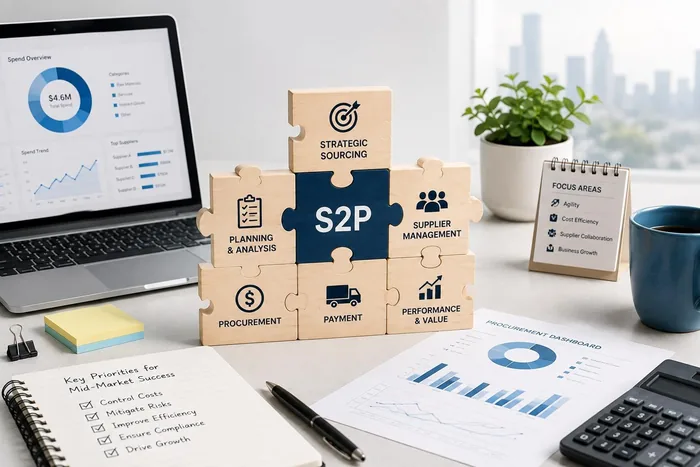
Source-to-Pay, or S2P, is the connected procurement process from identifying a business need through sourcing, supplier selection, contracting, purchasing, receiving, invoice matching, payment, and spend visibility. In theory, S2P is straightforward. In practice, many mid-market organizations still manage different parts of the process through email, Excel, shared drives, supplier portals, and disconnected applications.
The important thing to understand is that S2P is not the ERP, nor is the ERP a substitute for S2P. An ERP remains the system of record for financial and operational data, while an S2P platform provides procurement-specific workflows and connects the activities that happen before, around, and after the ERP transaction. S2P solutions typically bring together several major procurement processes and integrate tightly with the organization’s ERP to give users an easier way to handle complex transactions in a simple, secure, controlled, and easy-to-retrieve format.
If organizations do not have an S2P solution, they can still run procurement, and the process may be digital, but it is not necessarily connected or intelligent. Disconnected procurement creates friction, uses more resources, and is prone to costly leakages.
The Mid-Market Procurement Reality
In many mid-market organizations, procurement teams are lean. A team of five, seven, ten or up to thirty people may be responsible for strategic sourcing, supplier management, purchasing, contracts, compliance, supplier issues, and sometimes even invoice-related problems. There is simply not enough bandwidth to manage a complicated technology environment.
This is where the traditional enterprise S2P approach often breaks down. The company buys a sophisticated platform, spends months implementing it, configures hundreds of workflows, trains users, and then discovers that employees continue sending requests by email. The platform has been implemented. The process has not been transformed. One of the biggest changes ahead is that procurement technology will increasingly be judged by outcomes and adoption, powered quietly by AI in the background, rather than by the number of features it contains.
I have written about this broader challenge in “Why Procurement Teams Are Busier Than Ever – Yet Creating Less Strategic Value.” In many organizations, the problem is not simply that procurement needs more people. It is that too much procurement time is still consumed by repetitive, fragmented, and administrative work.
For mid-market organizations, it is therefore important that leaders clearly define what they expect from an S2P solution before they start comparing software.
1. Start With the Problem, Not the Solution
One of the biggest mistakes I see is starting an S2P project with a software feature checklist. Does it have sourcing? Does it have supplier management? Does it have contracts? Does it have invoicing? Does it have AI? Of course, those questions matter, but the first question should be: what should our end-to-end procurement process look like?
Map the journey from intake to payment first, then identify where manual work, delays, duplicate data, poor visibility, unnecessary approvals, and compliance gaps exist. Only then should you evaluate technology, including where AI can genuinely remove effort rather than simply sit on top as another feature.
This approach also connects directly with the lessons I shared in “10 Procurement Processes You Should Never Do Manually Again.” Automation and AI should remove friction, not simply move the same manual process into a new screen with a chatbot attached to it.
2. Prioritize Adoption Over Feature Count
A procurement platform can have every feature imaginable, AI included, and still fail if employees do not use it. This is especially important for mid-market companies. You probably do not have a dedicated team managing procurement technology adoption, so your procurement team needs a platform that employees, suppliers, finance, and business stakeholders can understand without extensive training.
This is why simplicity is not just a user experience issue. It is a procurement transformation issue. A simple, AI-assisted process that people actually use is more valuable than a sophisticated process people avoid. In my experience, the best S2P platform is not necessarily the one with the longest feature list. It is the one that gets the organization to consistently follow the right procurement process.
3. Connect Sourcing and Purchasing
Another common problem is treating strategic sourcing and transactional procurement as separate worlds. A sourcing event is completed, a supplier is selected, and negotiated pricing is agreed. Then the organization goes back to another system to take internal approvals, create purchase orders and manage invoices. That breaks the chain and often creates a weak link in the procurement organization, one that is prone to costly and hidden errors.
The real value of S2P comes from connecting the commercial decision to the transaction that follows it. The negotiated supplier, approvals, contract, price, terms, and execution schedule should flow naturally into purchasing and invoice processes. AI can add another layer of value by identifying when something starts to drift from what was agreed, whether it is a missed contracted rate, an unapproved item, a maverick order, or a supplier performance issue.
This is one reason the question of what to automate first is so important for every mid-market procurement leader. Do not automate isolated tasks. Connect the process, then let AI work across that connected data.
4. Treat Supplier Management as Part of S2P
Supplier management is another area where organizations struggle. Many companies have supplier information scattered across ERP records, spreadsheets, email, contracts, and individual employee files. That is not really supplier relationship management.
Modern supplier management needs to connect onboarding, qualification, risk, performance, collaboration, and transactions. AI is increasingly making it possible to monitor supplier risk and performance continuously, instead of relying only on periodic reviews.
For a mid-market organization, the answer does not have to be a complex SRM program. It needs a practical way to maintain reliable supplier information, capabilities, and performance data, keep that information current, and use it in everyday procurement decisions.
5. Make ERP Integration a Design Principle
Most mid-market companies already have an ERP. SAP, Microsoft Dynamics, Oracle, and other ERP systems remain important systems of record. The objective of S2P should not automatically be to replace the ERP. It should be to make procurement easier and smarter through automation and AI, while keeping the ERP at the center of financial and operational data.
This is particularly important for companies that want transformation without a multi-year technology program. A good S2P platform should work with the existing technology environment, feeding it clean data and drawing on it for procurement insight, rather than forcing the organization to rebuild everything around it.
The ERP should remain the system of record. The S2P platform should make procurement work better.
6. Measure Business Outcomes, Not Implementation Milestones
We have seen procurement projects celebrated simply because the platform implementation went live on schedule. That is not transformation. The real questions come later. Did sourcing cycle time decrease? Did negotiated savings increase? Did maverick spend decrease? Did supplier onboarding become faster? Did invoice exceptions decrease? Did employees actually adopt the new process, AI features and all? Can management see procurement activity and spend more clearly?
These are the metrics that matter.
This is also why I believe the future of procurement is moving toward greater procurement velocity, driven by connected processes, automation, and increasingly by AI, not simply greater procurement automation. The objective is to help procurement teams move faster while improving control.
As I discussed in “Why Procurement Will Look Completely Different by 2030,” the role of procurement is moving beyond transaction processing toward decision-making, risk management, supplier intelligence, and business value creation. Technology needs to support that shift rather than simply digitize today’s processes.
What Should a Mid-Market Company Look for in an S2P Platform?
Based on my experience, I would recommend looking for eight things:
- End-to-end S2P coverage
- A simple user experience
- Fast implementation
- Strong ERP integration
- Supplier adoption and collaboration
- Flexible workflows without excessive customization
- Practical AI built into the process rather than bolted on top
- Clear, measurable ROI
It is always a good idea to ask the shortlisted vendors to demonstrate one complete business cycle. Start with the requirement, and move through intake, sourcing, supplier selection, contracting, purchasing, receiving, invoice matching, approval, and payment, and ask specifically where and how the platform is creating value.
Do not evaluate two hundred isolated features. Evaluate whether the entire process works. That is a much better test of an S2P platform.
A Different S2P Strategy Does Not Mean a Smaller Strategy
This is an important distinction. I am not suggesting that mid-market companies should settle for basic procurement software. They need sophisticated procurement capabilities, including AI, delivered in a way a lean team can actually absorb. They simply need those capabilities delivered differently.
For example, procurEngine was built around the idea that a company should be able to connect intake, sourcing, supplier management, contracts, purchasing, invoicing, approvals, and spend visibility, with AI supporting decisions across the process, without creating unnecessary technology complexity.
The technology should adapt to the procurement process, not the other way around.
The Bottom Line
The biggest mistake a mid-market company can make is assuming that complex procurement software, or simply the presence of AI, automatically means better procurement transformation. It does not. For a lean procurement team, the winning S2P strategy is usually about connected processes, practical automation, AI applied where it genuinely saves time and reduces risk, high adoption, fast implementation, strong integration, supplier participation, and measurable results.
The goal should not be to implement the most sophisticated procurement platform you can afford. Your goal should be to create the most effective procurement operation your organization can actually run.
That is the difference between buying an S2P platform and transforming Source-to-Pay.
Questions about this article.
Why do mid-market companies need a different S2P strategy?
What should a mid-market company look for in S2P software?
Is S2P software the same as an ERP?
Should a mid-market company choose P2P or S2P software?
How can AI help a mid-market procurement team?
How should companies measure S2P implementation success?
How long does it take to implement S2P software in a mid-market company?
Can S2P software work with SAP or Microsoft Dynamics?
What procurement processes should be automated first?
Does a lean procurement team need a full S2P platform?
What is the biggest risk of implementing an S2P platform?
Is procurement automation enough for modern procurement?
About the Author
Anupam Aggrwal has spent more than 25 years handling negotiations and helping organizations improve procurement performance through process transformation, digitalization, and strategic sourcing. He also gives guest lectures to supply chain students at Mays Business School at Texas A&M University and the Eli Broad Graduate School of Management at Michigan State University.