
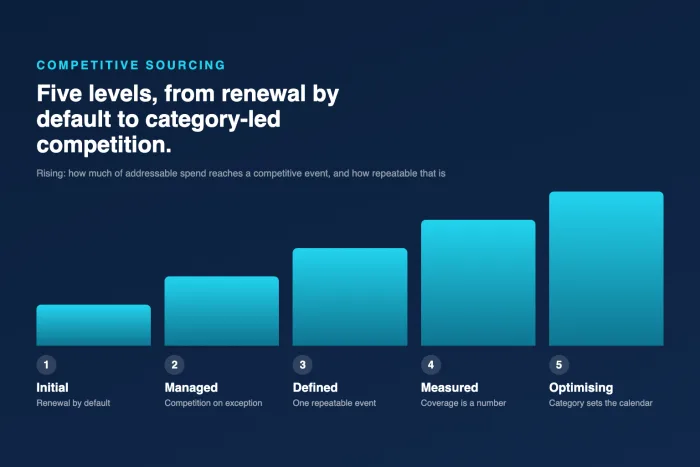
1 · Initial
Renewal is the default. Categories go back to the incumbent unless somebody objects, and competition happens when an individual pushes for it rather than because a process called for it.
procurEngine · 20 August 2026
Most procurement teams know roughly how good they are at running competitive events. Very few can say it precisely enough to plan against, and almost none can say it to a finance director in a way that survives a follow-up question.
This guide sets out five levels of competitive sourcing maturity, from renewal-by-default through to category strategy setting the sourcing calendar. Each level is described by what it actually looks like on a Tuesday morning (who decides that a category goes to market, how an event is run, what gets recorded) rather than by an abstract capability statement.
The structure follows the standard capability-maturity progression used across every industry: initial, managed, defined, measured, optimising. That is deliberate. It is a widely understood spine, it is not anybody's proprietary framework, and it lets a procurement leader place their function on a scale a CFO or a board already recognises from other disciplines.
This guide does not tell you how you compare to peers. A percentile would need a response base that does not exist yet, and inventing one would make every other number here less trustworthy. You get your level and what moves you up it, not a claim about anybody else.
Renewal is the default. Categories go back to the incumbent unless somebody objects, and competition happens when an individual pushes for it rather than because a process called for it.
Large categories go to market; the rest renew. Events happen, but the format varies by buyer, and what was compared is reconstructed afterwards from email rather than recorded at the time.
There is one way to run an event. RFx structure, evaluation criteria and award rationale are consistent and recorded, so a second person can audit a decision without asking the buyer what happened.
Coverage and outcome are known numbers. What share of addressable spend was competed, how many suppliers bid, and what each award was against its baseline, reportable without a data-gathering exercise first.
Category strategy sets the calendar. Event design is chosen per category rather than applied uniformly, the supplier pool is actively developed ahead of need, and results feed back into the next cycle.
Each level has one constraint that holds you there. The guide names it for all five, because the step from 3 to 4 is a different kind of work from the step from 1 to 2.
The move from level 2 to level 3 is a standardisation problem, and it is largely solvable by agreement: decide the event format, decide what gets recorded, and hold to both.
The move from 3 to 4 is different in kind. Consistency does not produce measurement on its own. You can run every event identically and still be unable to answer what share of our addressable spend went to market this year, because that question needs spend classified against the same categories the events were run in. Teams that treat level 4 as more discipline rather than as a data problem tend to stay at level 3 for years.
The cost of a low level is rarely a bad award. It is the awards that never happened: categories that renewed because nobody had the capacity to run an event, at a price nobody tested. That cost does not appear in any report, which is exactly why the level is worth naming.
Procurement leaders who need to describe their function's current state precisely, and sourcing managers building the case for what to fix first.
The full guide includes all five levels in detail, the single constraint that holds a team at each one, and what the step up actually involves.