
Procurement Debt: The Hidden Liability
By Anupam Aggrwal, CEO & Co-Founder · 8 June 2026
Executive Summary
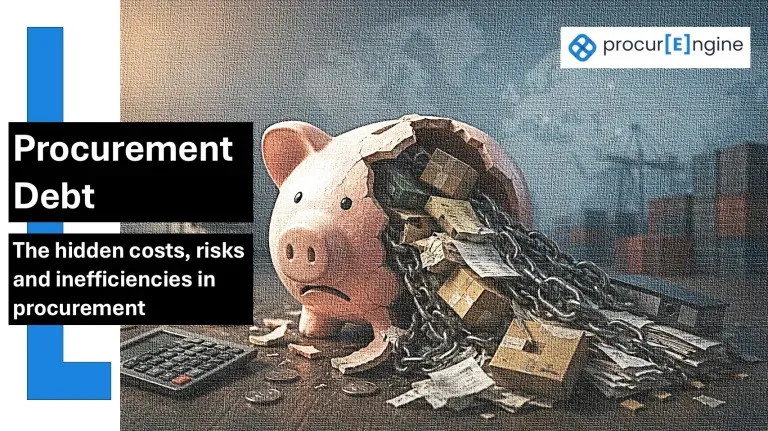
Most organizations carefully track financial debt and technology debt, yet few recognize another hidden liability that quietly impacts profitability, productivity, supplier performance, and business agility: Procurement Debt. Over time, unmanaged suppliers, outdated contracts, fragmented spend, process inefficiencies, poor data quality, and repeated policy exceptions accumulate like invisible liabilities within the procurement function. While these issues may appear manageable individually, together they create complexity, increase costs, slow decision making, and force procurement teams into constant firefighting.
In this article, we introduce the concept of Procurement Debt, explore its most common sources, explain how organizations unknowingly pay interest on it every day, and provide practical ways for procurement leaders, CFOs, CEOs, and CPOs to identify and reduce it. You will also find a Procurement Debt Assessment framework that can help evaluate your organization’s exposure and uncover opportunities to improve procurement productivity, strengthen supplier management, reduce risk, and create greater strategic value from procurement.
A CFO would never ignore financial debt. A CIO would never ignore technical debt. Yet many organizations unknowingly carry a third form of debt that rarely appears on a balance sheet, is seldom discussed in boardrooms, and quietly erodes value year after year.
We call it Procurement Debt.
Over the last decade, while working with more than 70 mid sized and large organizations across manufacturing, EPC, infrastructure, construction, healthcare, and services, I have observed a common pattern.
Many procurement challenges that organizations struggle with today are not caused by a single bad decision. They are the result of hundreds of small decisions, shortcuts, exceptions, and neglected improvements accumulated over time.
The result is Procurement Debt.
Like financial debt, it may appear manageable in the beginning. Like technical debt, it often remains invisible until it starts slowing down the business. And once it reaches a certain level, the organization spends more time managing problems than creating value.
What Is Procurement Debt?
Procurement Debt is the accumulated impact of procurement decisions, process shortcuts, unmanaged suppliers, outdated contracts, poor data quality, and neglected category strategies that create future inefficiencies, risks, and value leakage.
In simple terms, Procurement Debt is the gap between how your procurement function operates today and how it should operate to support business growth, profitability, resilience, and innovation. Most organizations do not intentionally create Procurement Debt.
It builds gradually with:
One supplier at a time.
One exception at a time.
One expired contract at a time.
One spreadsheet at a time.
Why Procurement Debt Matters More Than Ever
For many years, procurement was primarily evaluated on cost savings. Today the expectations are much higher.
Procurement leaders are expected to deliver:
- Cost optimization
- Supply chain resilience
- Risk management
- Supplier innovation
- Sustainability goals
- Working capital improvements
- Business agility
Yet many procurement teams remain trapped in operational firefighting. This is often not a capability issue. It is a Procurement Debt issue.
Organizations carrying significant Procurement Debt spend much of their energy maintaining complexity rather than creating value.
The Seven Sources of Procurement Debt
1. Supplier Proliferation Debt
Most organizations have typically 12-15 times suppliers than they actively manage. Over time, duplicate suppliers, inactive suppliers, and fragmented supplier bases increase administrative effort and reduce negotiation leverage.
Every unnecessary supplier adds complexity. Complexity eventually becomes debt.
2. Contract Debt
Many organizations discover that a significant percentage of contracts are:
- Expired
- Auto renewed
- Missing performance reviews
- Based on outdated commercial terms
Contract Debt often leads to missed savings opportunities, increased risk exposure, and weaker supplier accountability.
3. Category Strategy Debt
Some categories receive strategic attention. Many do not. When categories are managed transactionally rather than strategically, organizations lose opportunities to leverage market intelligence, supplier competition, and long term sourcing strategies.
This creates Category Strategy Debt.
4. Procurement Data Debt
Data is the foundation of modern procurement. Unfortunately, many organizations struggle with:
- Duplicate supplier records
- Incomplete supplier profiles
- Poor spend classification
- Inconsistent reporting structures
Without reliable data, procurement decisions become slower and less effective.
5. Process Debt
One of the most common forms of Procurement Debt is process complexity.
- Multiple approval layers.
- Email driven workflows.
- Manual reporting.
- Spreadsheet based tracking.
These practices consume valuable time that should be spent on strategic procurement activities.
In fact, many of the productivity challenges discussed in our earlier article, “Why Procurement Teams Are Busier Than Ever Yet Creating Less Strategic Value,” are direct consequences of Process Debt.
6. Supplier Relationship Debt
Supplier relationships often become purely transactional. Organizations focus heavily on pricing discussions while neglecting:
- Performance reviews
- Innovation programs
- Strategic collaboration
- Joint value creation
Over time, the relationship weakens. The opportunity cost becomes substantial.
7. Compliance Debt
- Emergency purchases.
- Policy exceptions.
- Maverick spending.
- Contract bypasses.
Initially these may seem harmless. Repeated over time, they become Compliance Debt that increases risk and reduces procurement effectiveness.
The Interest Payment on Procurement Debt
The most dangerous aspect of Procurement Debt is that organizations pay interest every day. Not financial interest. Operational interest.
The interest appears as:
- Longer sourcing cycles
- Higher supplier costs
- Increased administrative effort
- Lower procurement productivity
- Reduced supplier innovation
- Poor spend visibility
- More stakeholder frustration
- Increased risk exposure
This is often why procurement teams remain busy while struggling to create proportional strategic value.
How CFOs and CEOs Can Spot Procurement Debt
A simple way to identify Procurement Debt is to ask five questions.
- How many active suppliers do we have compared to the number we actively manage?
- What percentage of spend is covered by current contracts?
- How much procurement reporting is still manually prepared?
- What percentage of sourcing activity follows a structured category strategy?
- How much time does the procurement team spend on administration versus strategic sourcing?
If the answers are unclear, there is a strong possibility that Procurement Debt exists.
The Procurement Debt Assessment
To help procurement leaders evaluate their exposure, score your organization from 1 to 5 on each area below.
| Area | Score (1 to 5) |
|---|---|
| Supplier Base Management | |
| Contract Governance | |
| Category Strategy | |
| Data Quality | |
| Process Efficiency | |
| Supplier Performance Management | |
| Compliance and Controls | |
| Spend Visibility | |
| Technology Adoption | |
| Strategic Sourcing Coverage |
Score Interpretation
- 10 to 20: Critical Procurement Debt
- 21 to 30: High Procurement Debt
- 31 to 40: Moderate Procurement Debt
- 41 to 50: Low Procurement Debt
Organizations scoring below 30 should prioritize debt reduction initiatives before investing heavily in additional procurement resources.
Procurement Debt Scorecard
We at procurEngine have converted this framework into a detailed Procurement Debt Assessment designed specifically for mid sized organizations.
The assessment evaluates:
- Supplier complexity
- Contract exposure
- Process maturity
- Procurement productivity
- Data quality
- Strategic sourcing capability
The result is a Procurement Debt Score along with recommended improvement priorities. If you are a procurement leader and would like a copy of the assessment framework, connect with us and we will be happy to share it. Please reach us at procurengine.ai or reach me directly at: [email protected]
How Leading Organizations Reduce Procurement Debt
The most effective organizations focus on five areas.
1. Simplify the Supplier Base
Rationalize suppliers and eliminate unnecessary complexity.
2. Strengthen Contract Governance
Ensure contracts remain current, visible, and actively managed.
3. Build Category Strategies
Move beyond transactional procurement and establish long term sourcing plans.
4. Improve Data Quality
Reliable procurement intelligence starts with reliable procurement data.
5. Digitize Procurement Operations
Technology should reduce administrative effort and increase strategic capacity.
Related Reading
If you found this article useful, you may also enjoy:
- Why Procurement Teams Are Busier Than Ever Yet Creating Less Strategic Value
- Why Procurement Value Is Created in Negotiation, Not Processing
- How to Transform Your Supplier Negotiation Strategy Using the Kraljic Matrix
- 5 Things Smart CPOs Audit Every Quarter Before the Board Meeting
- Blind Spots in Procurement: The Hidden Cost of Approved Supplier Lists
Together, these topics provide a practical roadmap for building a more strategic and resilient procurement function.
Final Thoughts
Financial debt impacts the balance sheet. Technical debt impacts systems. Procurement Debt impacts competitiveness. The challenge is that Procurement Debt rarely appears in quarterly reports.
Its impact is felt through slower decisions, weaker supplier performance, increased complexity, missed savings, and constant firefighting.
The organizations that identify and reduce Procurement Debt today will be better positioned to compete, innovate, and grow tomorrow. The most dangerous liabilities in procurement are often the ones nobody is measuring.
Perhaps it is time we start measuring Procurement Debt.
People Also Ask
What causes procurement teams to become overwhelmed?
Procurement teams often become overwhelmed due to manual processes, excessive approvals, supplier complexity, poor data quality, and lack of process standardization.
Is Procurement Debt similar to Technical Debt?
Yes. Both accumulate gradually through deferred improvements and shortcuts. Over time, both create inefficiencies, increased costs, and operational complexity.
How can organizations measure Procurement Debt?
Procurement Debt can be assessed through supplier management effectiveness, contract coverage, process maturity, spend visibility, compliance levels, and strategic sourcing coverage.
What is the business impact of Procurement Debt?
Procurement Debt can lead to higher costs, slower sourcing cycles, increased risk, lower productivity, weaker supplier relationships, and missed value creation opportunities.
How can procurement leaders reduce Procurement Debt?
Procurement leaders can reduce Procurement Debt through supplier rationalization, contract governance, category management, process simplification, data improvement, and digital transformation initiatives.
Why should CEOs care about Procurement Debt?
Procurement Debt directly impacts competitiveness, profitability, operational agility, supply chain resilience, and long term business growth.
Questions about this article.
What is Procurement Debt?
Why is Procurement Debt important for CFOs?
How does Procurement Debt affect procurement productivity?
What are the most common sources of Procurement Debt?
Can procurement technology reduce Procurement Debt?
How often should organizations assess Procurement Debt?
About the Author
Anupam Aggrwal is the CEO and Co-Founder of procurEngine and has spent more than 25 years handling negotiations and helping organizations improve procurement performance through process transformation, digitalization, and strategic sourcing. He also gives guest lectures to supply chain students at Mays Business School at Texas A&M University and the Eli Broad Graduate School of Management at Michigan State University.